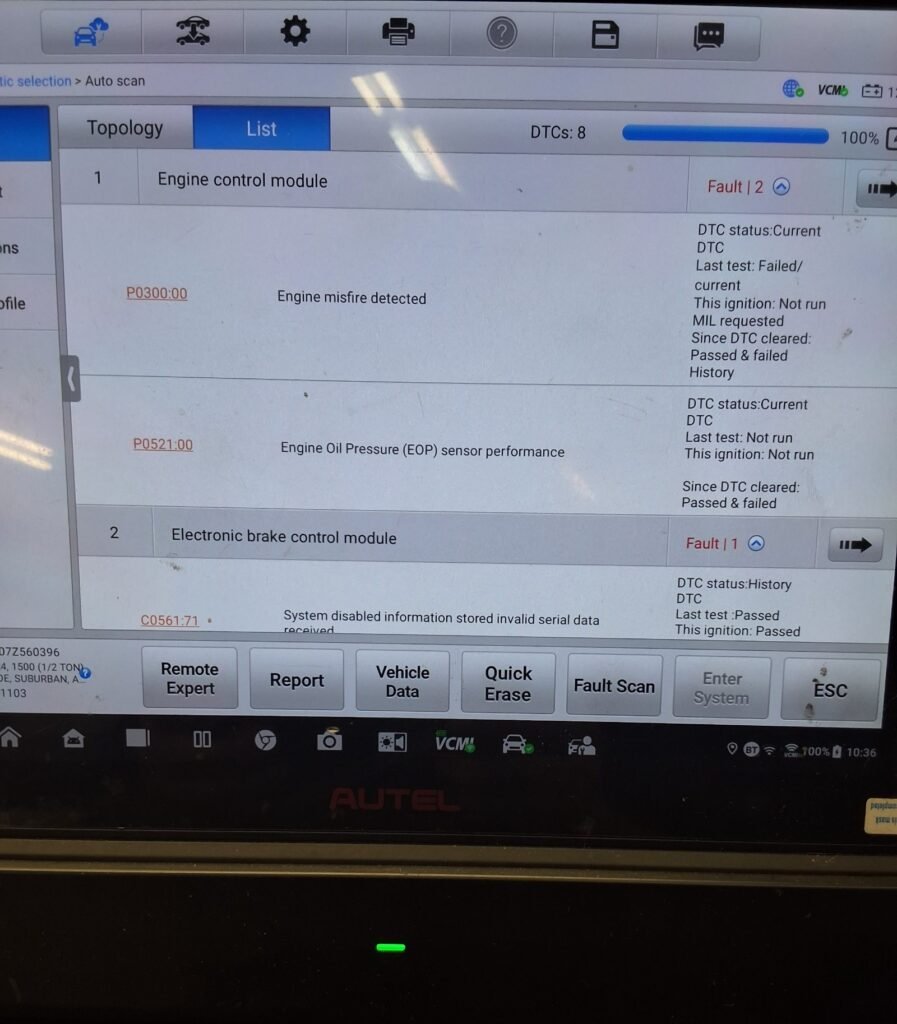
P0300 Engine Misfire Detected.
That sounds pretty broad.
And it is.
But on a recent 2007 Chevrolet Silverado 1500 with a 5.3L V8, the live data told us something much more specific than the code description did.
This truck had more than 265,000 miles and came to Chuck’s Auto Repair – Shoreline with the check-engine light on.
The computer was reporting P0300.
But when our technician looked beyond the code and watched the actual misfire data, cylinders #5 and #6 weren’t misfiring randomly.
They were consistently misfiring together.
That pattern changed the direction of the diagnosis.
Instead of assuming the truck simply needed spark plugs, coils or another common ignition repair, the evidence pointed toward a possible mechanical engine problem.
And once the engine was opened for inspection, we found one.
P0300 Was the Code But the Live Data Told the Better Story
This is an important distinction whenever we diagnose a check-engine light.
A trouble code gives us information.
It can identify a system or operating condition the computer has detected.
But the code description isn’t necessarily the whole diagnosis.
On this Silverado, P0300 indicated an engine misfire.
Then the live data showed the important pattern:
Cylinder #5 was repeatedly misfiring.
Cylinder #6 was repeatedly misfiring.
And they were counting misfires at the same time.
The technician noted that those cylinders were being served by the same camshaft.
That made a shared mechanical problem worth investigating.
So rather than treating P0300 as a shopping list for ignition parts, the diagnostic plan moved toward mechanical testing.
Why Cylinders 5 and 6 Misfiring Together Mattered
Suppose a scan tool simply tells us:
“Random misfire.”
One approach would be to immediately start replacing likely ignition components.
But that’s not what the data on this truck was telling us.
The misfires were consistently accumulating on two particular cylinders at the same time.
That suggested there could be a common reason those cylinders weren’t operating correctly.
The technician wanted to determine whether the problem was electrical, fuel-related or mechanical before committing to a repair.
That’s why the next step moved deeper into the engine.
The Next Step Was Mechanical Testing
A compression test was approved as part of the diagnostic process.
That required removing the spark plugs and testing the engine mechanically.
The repair order does not record the individual compression readings, so we’re not going to invent numbers that aren’t there.
What it does document is that the diagnostic process continued to the next step:
removing the valve cover and inspecting the camshaft and valvetrain.
That’s an important progression.
The code started the investigation.
Live data narrowed the pattern.
Mechanical testing and inspection were needed to find the physical cause.
Then the Valve Cover Came Off
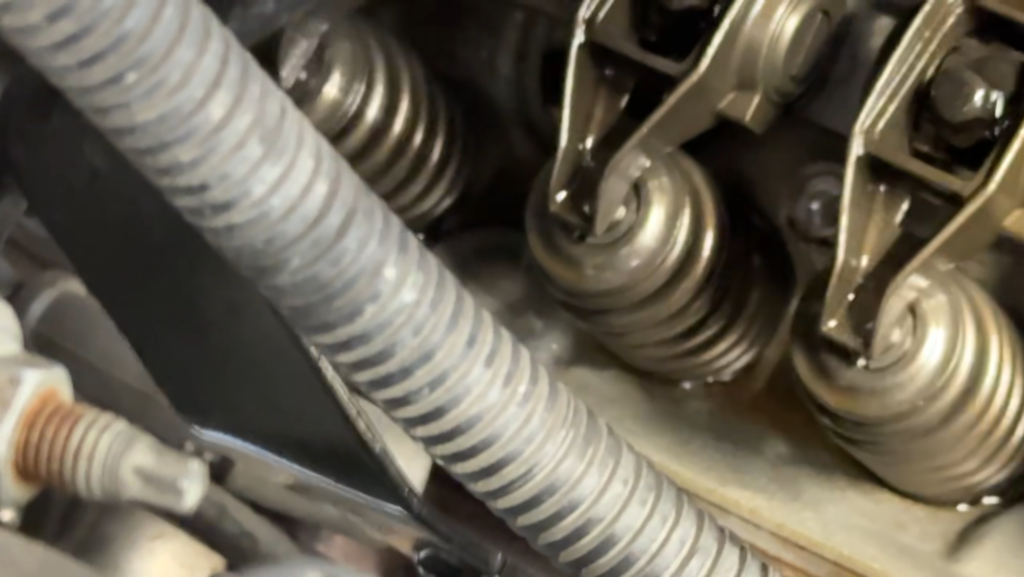
Once the passenger-side valve cover was removed, the technician could actually inspect what the valvetrain was doing.
That’s when the problem became visible.
The technician found the #6 exhaust-side rocker frozen.
The exhaust valve was not moving.
At that point, we weren’t dealing with a vague “random misfire” anymore.
We had a physical mechanical failure inside the engine.
This Is Why a P0300 Code Doesn’t Automatically Mean Spark Plugs
Misfires can have different causes.
That’s why a P0300 code by itself doesn’t tell a technician:
or:
or:
The repair has to follow the evidence.
On this Silverado, the evidence kept pointing deeper:
P0300
then
consistent #5 and #6 misfires
then
mechanical testing
then
valve cover removal
and finally
a frozen #6 exhaust rocker with the exhaust valve not moving.
That is very different from diagnosing the truck from the code description alone.
Why Didn’t We Just Repair the Cylinder Head?
Once the mechanical failure was visible, another decision had to be made.
Could the repair continue by removing the cylinder head and addressing the failed valvetrain components?
Or, given the repair required and the condition of this particular truck, did replacing the engine make more economic sense?
The technician documented that rather than removing the cylinder head for the repair, engine replacement would be the more cost effective path for this vehicle.
That recommendation was specific to this Silverado.
It does not mean every 5.3L Silverado misfire should lead to an engine.
The engine had to earn that recommendation through diagnosis first.
A 265K-Mile Truck Changes the Repair Conversation
This Silverado had traveled 265,296 miles.
That’s useful context.
But mileage by itself didn’t diagnose the engine.
We didn’t say:
“It’s over 265,000 miles, so it needs an engine.”
The mechanical evidence came first.
Mileage becomes important when discussing what repair path makes sense after the failure has been identified.
On a high mileage vehicle facing a major internal engine repair, the owner and shop may have more than one possible path to consider.
The right decision depends on the actual failure, repair scope, vehicle condition and what makes sense for that particular owner.
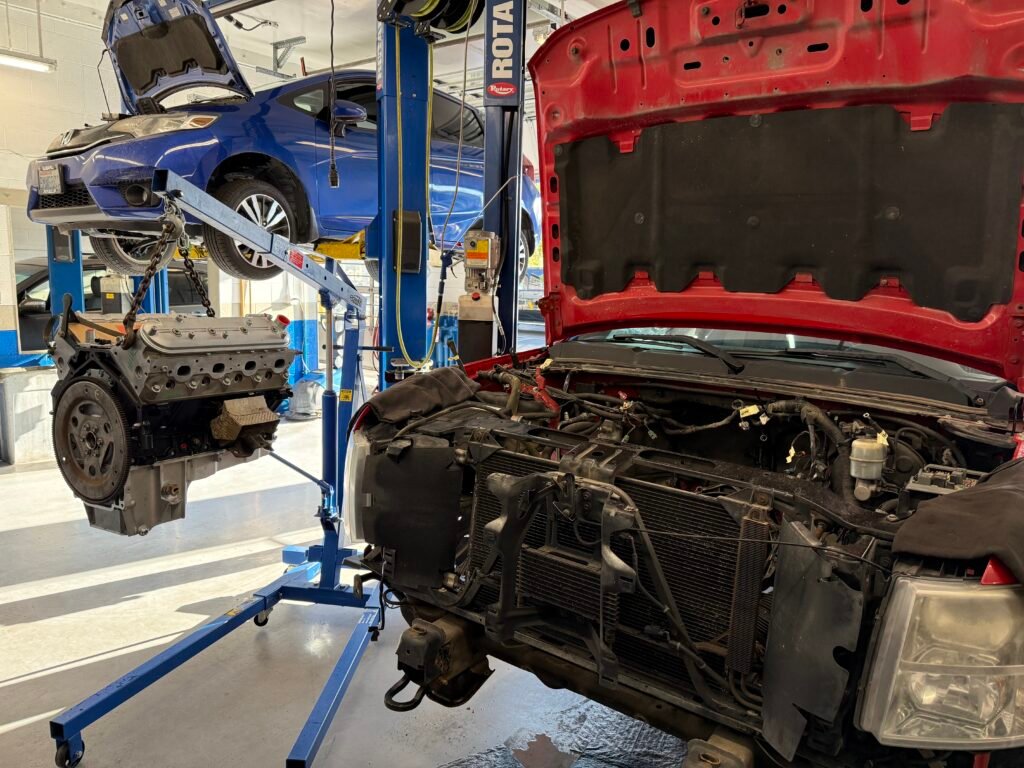
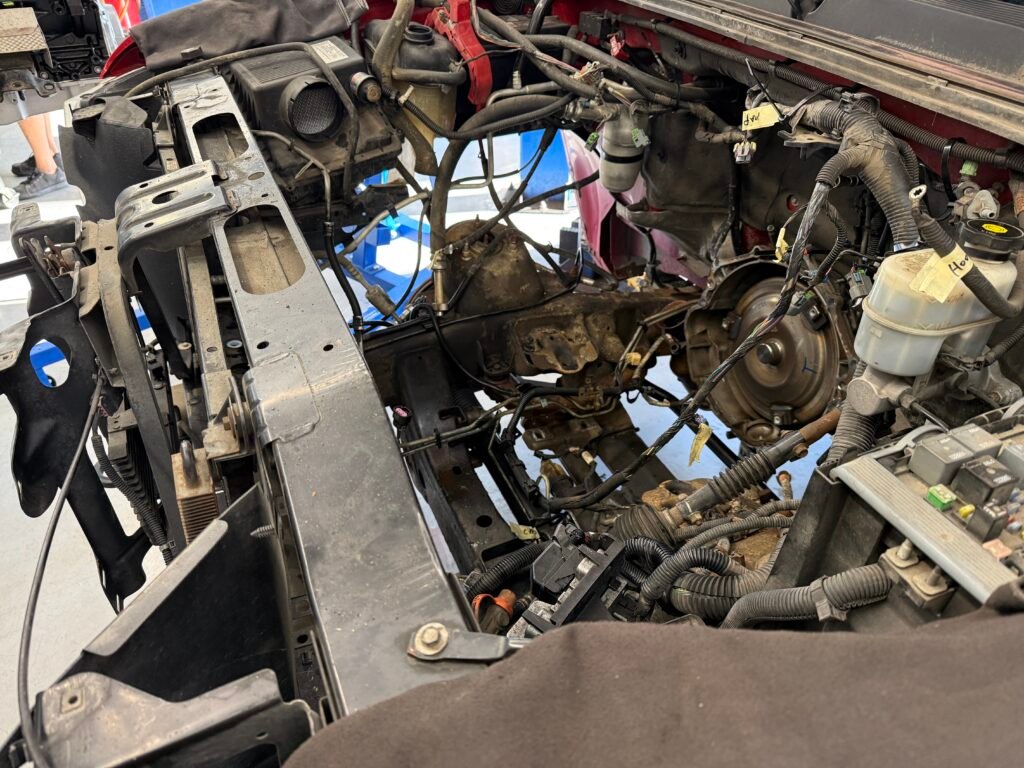
The Engine Came Out
Once the engine replacement was approved, this became a major repair.
The real shop photos show the engine being removed from the Silverado and the front of the truck opened up for access.
This is another reason good diagnosis matters.
Before getting anywhere near this level of disassembly, we want a clear reason for doing it.
An Engine Replacement Is More Than Just the Long Block
The approved repair on this Silverado included much more than physically swapping the engine itself.
The repair plan included a replacement long block and the labor required to transfer necessary components.
There was also a vehicle specific oil pan issue.
The replacement engine’s oil pan did not have the oil level sensor provision used by this truck, so the correct oil pan had to be installed for the Silverado’s configuration.
The approved repair plan also included related components such as:
radiator hoses
thermostat
drive belts
spark plugs
spark-plug wires
and
camshaft position sensor
as required for this installation.
That’s worth explaining because customers sometimes see an engine replacement estimate and wonder why it contains components other than “the engine.”
A large repair has to account for the actual vehicle configuration and the supporting components involved in making the installation complete.
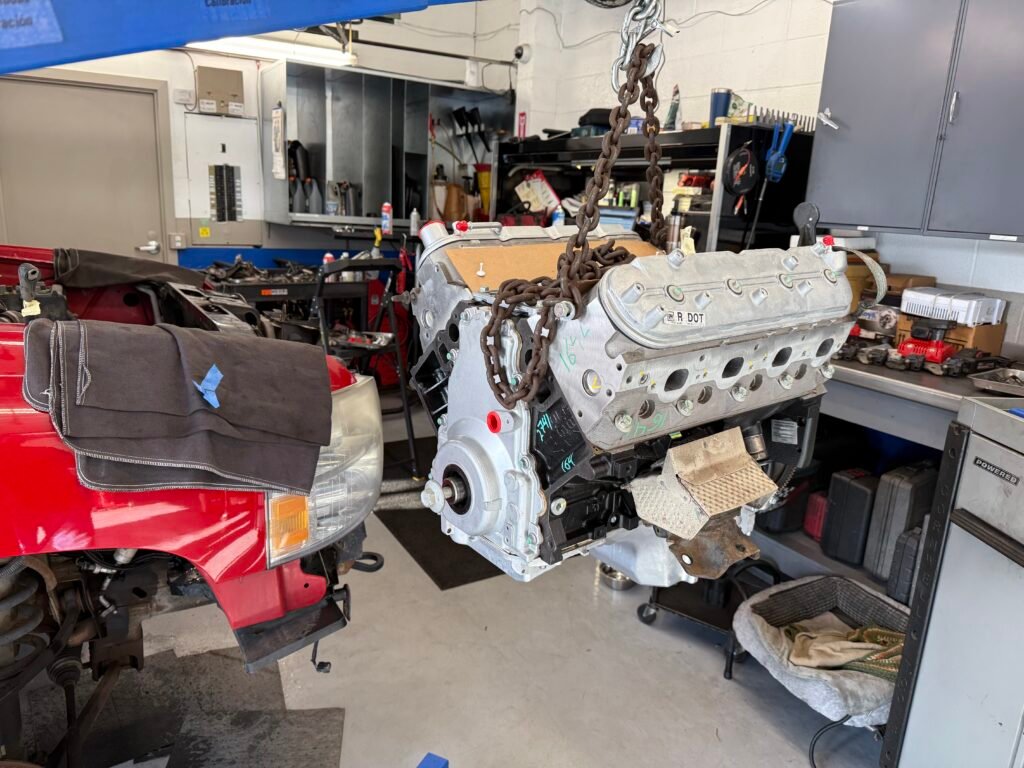
Then the Replacement Long Block Was Prepared
The final repair photos also show the replacement long block ready for installation.
It’s a dramatic difference from where the diagnostic process began.
This repair started with:
one check engine light
and
one broad P0300 misfire code.
It ended with confirmed mechanical valvetrain damage and a replacement engine.
The important part isn’t the size of the repair.
The important part is how we got there.
Why This Silverado Is a Good Example of “Code ≠ Diagnosis”
If we reduced this repair to one sentence, we could say:
“The truck had P0300 and needed an engine.”
But that would skip the most important part.
P0300 did not tell us to install an engine.
The diagnostic process did.
The actual sequence was:
Check-engine light
↓
P0300 misfire fault
↓
live data showing cylinders #5 and #6 consistently misfiring together
↓
mechanical testing
↓
valve-cover removal
↓
frozen #6 exhaust rocker / exhaust valve not moving
↓
repair-path decision
↓
engine replacement
That’s a much more accurate picture of what modern automotive diagnosis actually looks like.
What If Your Silverado Has P0300?
Don’t assume the worst.
And don’t assume the easiest repair either.
P0300 tells us a misfire has been detected.
The next question is:
Where is the misfire actually happening, and why?
Useful diagnostic information can include:
which cylinders are counting misfires,
whether the misfire is constant or intermittent,
when it happens,
engine operating conditions,
ignition and fuel-system information,
compression and mechanical condition,
and what inspection shows.
Your Silverado may have a completely different cause from the truck in this article.
That’s why it still needs its own diagnosis.
Should You Keep Driving With a Misfire?
A persistent misfire deserves attention.
If the engine is running rough, shaking, losing power or the check engine light begins flashing, continuing to drive can potentially create additional problems.
You don’t need to figure out whether it’s a plug, coil, injector, valve or internal engine problem yourself.
Tell us what the truck is doing.
We’ll work from the symptom and the evidence.
What If a Parts Store Scan Says P0300?
Bring the code with you.
It’s useful information.
Just don’t confuse:
reading the code
with
knowing which part needs replacement.
This Silverado is a perfect example.
The first scan provided a broad misfire code.
The more useful information came from watching which cylinders were actually misfiring and then mechanically verifying why.
Chevy Silverado P0300 FAQ
What does P0300 mean on a Chevy Silverado?
On this Silverado, P0300 was reported as an engine misfire fault. It told the technician that the engine computer had detected misfiring, but additional data and mechanical testing were required to find the actual cause.
Does P0300 mean I need spark plugs?
Not automatically. Spark plugs can be involved in some misfires, but P0300 alone does not identify the failed part. This Silverado ultimately had a mechanical valvetrain problem.
Why did cylinders 5 and 6 matter?
On this truck, live data showed cylinders #5 and #6 misfiring consistently and at the same time. The technician recognized that pattern as important because both were being served by the same camshaft, which helped justify further mechanical investigation.
What did the technician find under the valve cover?
The repair documentation states that the #6 exhaust-side rocker was frozen and the exhaust valve was not moving.
Did the P0300 code itself mean the engine needed replacement?
No. P0300 started the diagnostic process. Live misfire data, mechanical testing and physical valvetrain inspection led to the engine-replacement recommendation.
Does every high mileage Silverado with P0300 need an engine?
No. This article describes one real 2007 Silverado 5.3L repair. Another Silverado with P0300 may have an entirely different cause and needs its own diagnosis.
Chevy Silverado Check Engine and Misfire Diagnosis in Shoreline
If your Silverado has a P0300 code, a check engine light or an engine misfire, you don’t need to guess which part needs replacing before making an appointment.
Tell us what the truck is doing.
We’ll inspect and test the vehicle, explain what the evidence shows and recommend the repair based on what we actually find.
Chuck’s Auto Repair – Shoreline
14501 15th Ave NE
Shoreline, WA 98155
206-368-0980
Schedule service through the current Book Online / Schedule Appointment Link.