
Ford Transit Grinding or Clacking on Cold Start? Why a Noise That Goes Away Warm Still Matters
We’ve been seeing more Ford Transit vans come through our Shoreline shop with a similar type of concern.
The owner starts the van cold and hears something ugly from the engine area. It may sound like grinding, clacking, or rattling. Then the engine warms up and the noise becomes much less noticeable.
That second part makes the problem easy to postpone.
The van still starts. It still gets to the job. The noise doesn’t last all day.
But a noise that changes as the engine warms is still useful diagnostic information.
One recent Ford Transit in our shop is a good example.
A 2019 Transit 250 With Only About 76,000 Miles
A 2019 Ford Transit 250 with the 3.7L V6 came into Chuck’s Auto Repair – Shoreline with just over 76,000 miles.
The owner’s description was specific.
There was a grinding or clacking noise from the engine area on cold start. As the engine warmed up, the noise dissipated. The engine also seemed to be running a little rough, and the owner wondered whether it might simply be time for a good tune-up.
We verified the noise.
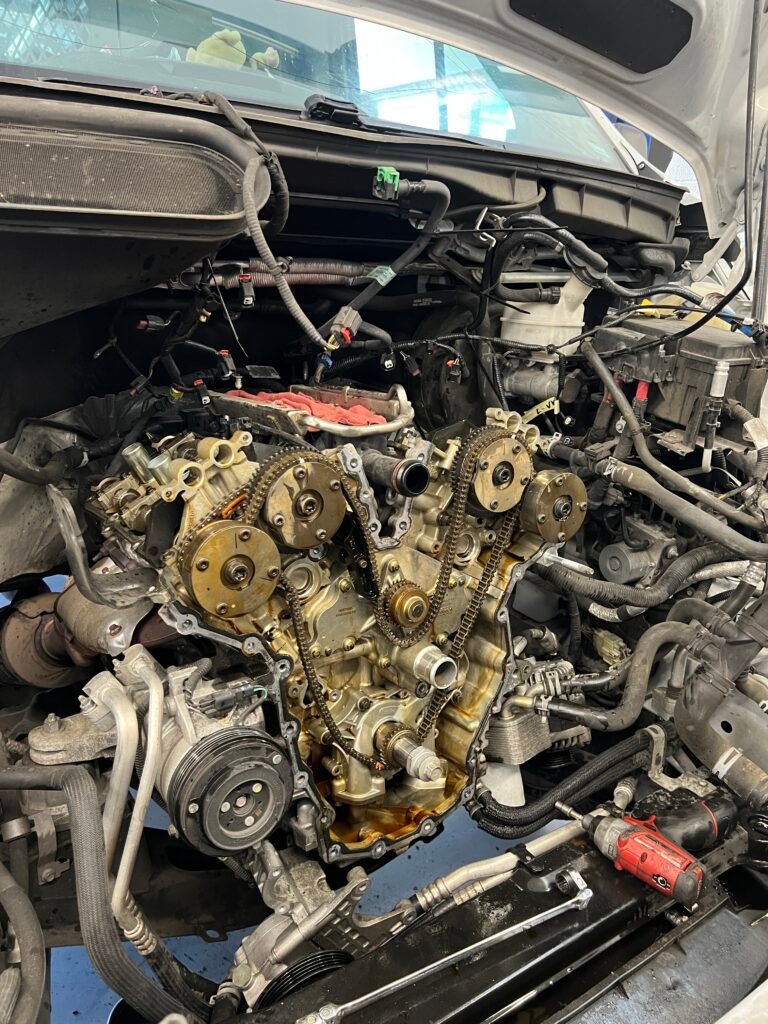
Our inspection localized it to the area behind the timing cover and valve covers. The repair ultimately required replacement of the engine timing-chain system, including the timing components and all four variable-valve-timing sprockets.
That’s a substantial repair on a van with mileage many owners would not consider especially high.
It is also important to say what this example does not mean.
It does not mean every Ford Transit that rattles when cold needs a timing chain.
The sound is the clue. The diagnosis tells us what’s making it.
Why Does the Noise Getting Quieter Warm Matter?
Cold start creates a different operating condition from an engine that has already been running.
Oil has been sitting. Oil pressure and circulation have to establish themselves after startup. Engine clearances and operating conditions change as components warm. Variable cam timing and timing-system components begin operating from that cold-start condition.
That makes the pattern important.
When does the noise start?
How long does it last?
Does it change with engine speed?
Does it disappear completely once the engine is warm?
Does it happen after sitting overnight but not after a short stop?
Those details can help narrow the diagnostic path considerably.
What we don’t want to do is assume:
“It went away, so everything must be fine.”
The fact that a noise changes with temperature and operating time may actually be one of the most useful clues.
There’s More Behind the Timing Cover Than One Chain
The 2019 Transit 3.7L uses variable camshaft timing.
From a repair standpoint, that means talking about “the timing chain” can oversimplify what is actually inside the system.
The timing system includes components such as chains, guides, tensioning components, and variable-cam-timing sprockets.
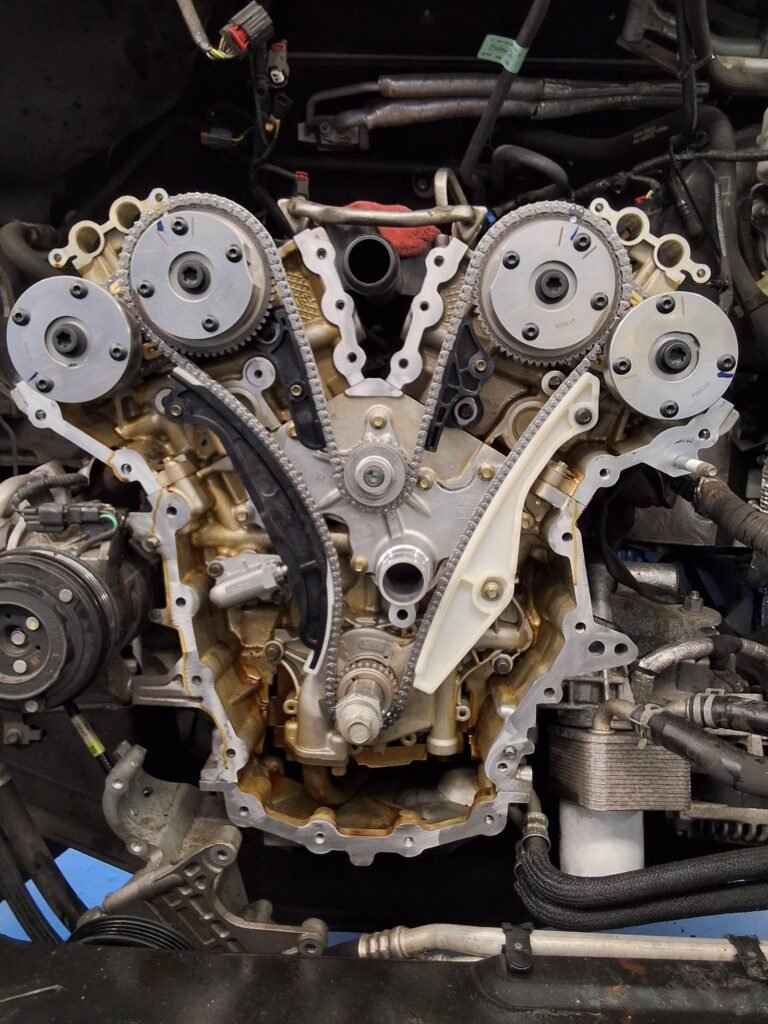
On our recent 76,000-mile Transit, the repair included the timing-chain system and all four VVT camshaft sprockets, two intake and two exhaust.
That’s why an accurate diagnosis matters before parts are ordered.
The customer hears a noise.
Our job is to figure out which component is producing it and what needs to be repaired.
A Cold-Start Rattle Does Not Automatically Mean the Timing Chain Is Bad
There are other potential sources of noise from the front or upper engine area.
Depending on the exact vehicle and symptom, diagnosis may need to consider things such as:
- Accessory-drive components
- Pulleys and bearings
- Variable-cam-timing components
- Oil level and condition
- Oil-pressure or lubrication-related concerns
- Water-pump or other rotating-component noise
- Internal mechanical components
Two noises that sound very similar from the driver’s seat can have completely different causes.
So if somebody says every Transit making this type of noise needs timing-chain work, that’s too broad.
What we can say from our own shop experience is that we’ve been seeing more Transit owners come in with cold-start engine-noise concerns.
One recent 3.7L Transit with about 76,000 miles ultimately required a substantial timing-system repair.
Those are two different statements, and the distinction matters.
“Maybe It Just Needs a Tune-Up”
That was also part of the concern on our recent Transit.
The engine seemed slightly rough, and the owner wondered whether it might be time for a tune-up.
That’s a reasonable thought.
But modern vehicle maintenance doesn’t work well when every rough-running complaint gets treated as “put spark plugs in it and see what happens.”
Spark plugs and ignition maintenance may be appropriate when they’re due based on the engine and service history.
A mechanical grinding or clacking sound is a different concern.
If we’re hearing abnormal noise from the timing-cover area, ordinary maintenance parts don’t answer the question of what’s making that noise.
We diagnose the complaint first.
Then maintenance items can be handled based on the van’s actual history and requirements.
The Decision Gets Harder When Your Transit Is Your Business
This is where Ford Transit ownership can be very different from owning a passenger car.
For an electrical contractor, the Transit may be carrying tools, wire, ladders, fittings, meters, and equipment needed for every job that day.
For an HVAC or service company, it may be loaded with tools, parts, and equipment and already scheduled for several customer calls.
The van isn’t just how you get to work.
The van is part of the work.
So when it makes a bad noise for a few seconds in the morning and then settles down, taking it out of service can seem like the least convenient option.
The schedule is full.
The equipment is already loaded.
Customers are expecting someone to arrive.
The noise went away.
Maybe next week.
Then next week gets just as busy.
Planned Downtime Gives You More Choices
We’re not suggesting that every cold-start noise means a Transit is about to stop running.
That’s exactly why diagnosis matters.
The goal is to find out what you’re dealing with while you still have choices.
If an inspection shows that the noise is coming from something relatively minor, you’ve gained useful information.
If it shows that a repair needs to be planned, a commercial operator can begin deciding when the van can come out of service, whether tools need to be transferred, and how work needs to be scheduled.
Planned downtime is inconvenient. Unplanned downtime usually gives a business fewer choices.
For a work van, that’s part of the repair decision too.
Mileage Doesn’t Cancel Out a Symptom
The Transit in our recent example had just over 76,000 miles.
It’s easy to think:
“It can’t be anything major. It doesn’t have enough miles.”
But mileage is only one piece of information.
If an engine develops a new mechanical noise, the odometer doesn’t override what the engine is telling you.
At the same time, our 76,000-mile example does not mean Transits require timing work at 76,000 miles.
There is no universal mileage where we would tell every Transit owner to replace the timing-chain system.
The point is much simpler:
Don’t dismiss an abnormal noise solely because the mileage seems too low for a major repair.
What We Want to Know When Your Transit Comes In
A good description from the driver can save a lot of guessing.
Instead of simply saying “engine noise,” tell us:
- Does it happen only on the first start of the day?
- Is the engine completely cold?
- Does it grind, clack, knock, or rattle?
- How long does it last?
- Does engine speed change the noise?
- Does it disappear after warm-up?
- Has it been getting louder or lasting longer?
- Does the engine also run rough?
- Are any warning lights on?
- Has anything else changed recently?
If several employees drive the same van, ask the person who hears the noise most often what they notice.
Those details matter.
Sometimes We Need to Hear the Van Cold
A van that sounds terrible at 7 a.m. may be perfectly quiet by the time it reaches the repair shop.
That can make an intermittent problem harder to reproduce.
If the complaint only happens after the Transit sits for several hours or overnight, tell us when scheduling the appointment.
When practical, we may need the vehicle in a condition where the symptom can actually be reproduced rather than trying to diagnose a cold-start concern after the engine has already warmed up.
Being specific about when the noise happens can be every bit as helpful as describing what it sounds like.
A short phone video recorded during the cold start may also help document an intermittent sound if the van becomes quiet before it reaches the shop.
What We Check Before Calling It a Timing Problem
The diagnostic process depends on the symptom, but the principle is straightforward:
We verify before we condemn parts.
That can include listening to the engine under the conditions where the complaint occurs, determining where the sound is strongest, reviewing oil and maintenance history, checking for related faults or operating-data clues when appropriate, inspecting accessible components, and deciding whether additional access is justified.
In our recent Transit example, inspection localized the noise behind the timing and valve-cover area.
The diagnostic path then led into the timing system rather than simply treating the van for a generic rough-running complaint.
That’s the difference between hearing a symptom and diagnosing its source.
When Should You Get a Ford Transit Engine Noise Checked?
A new mechanical noise is worth investigating, particularly if:
- It is getting louder
- It is lasting longer after startup
- The engine is also running rough
- Performance has changed
- A warning light appears
- The noise is present warm as well as cold
- You depend on the van every day for work
You don’t need to decide whether it’s a timing chain before making the appointment.
That’s our job to figure out.
What helps us is knowing when it happens and exactly what you’ve noticed.
Your Work Van Doesn’t Need Another Guess
If your Ford Transit makes a grinding, clacking, or rattling noise when it’s cold and then quiets down after warming up, don’t assume that the disappearing noise answers the question.
It doesn’t.
The sound is the clue. The diagnosis tells us what’s making it.
And when that Transit is carrying the tools and equipment for your electrical contracting, HVAC, or service business, knowing what you’re dealing with can make it easier to plan the next step instead of waiting for the van to choose the schedule for you.
Need help with a Ford Transit engine-noise concern?
Call Chuck’s Auto Repair – Shoreline at 206-368-0980 or schedule service through the current booking option at Book Now Here
Tell us if the noise happens specifically on cold start so we can plan the diagnostic visit around the symptom.